Who Can't Be at the Table
David Elisma recounts how a moment at Festi-Mosaïque reminded him why he is running for the CECCE, in Zone 6, as the school year approaches.
Back to School
Back to school arrives this week for some families, next week for others. Parents are buying supplies right now. Within days, their children will walk through the doors of schools whose year was decided months ago — not in the classroom, not in the principal's office, but at a table.
That is where the budget, the staffing and the services get settled. That is where what those children will find on their way in gets voted on.
Saturday, and the Same Question
On Saturday, at Festi-Mosaïque and at other community gatherings across the neighbourhood, I was asked the same question, over and over: "Why are you running?"
I had an answer ready. I've been giving it since the start. I talk about the default. In Ontario, the school support of francophone ratepayers is assigned by default to the English-language public school board. Without a different designation, you cannot vote in the French-language Catholic school board election. So I say: go check your designation, register, break the default, so you can vote on October 26, 2026.
It's true. It matters. The designation doesn't move anyone's money and doesn't change what anyone pays. It confers the right to vote. It's a mechanism — a step I'm asking voters to take.
The Stage
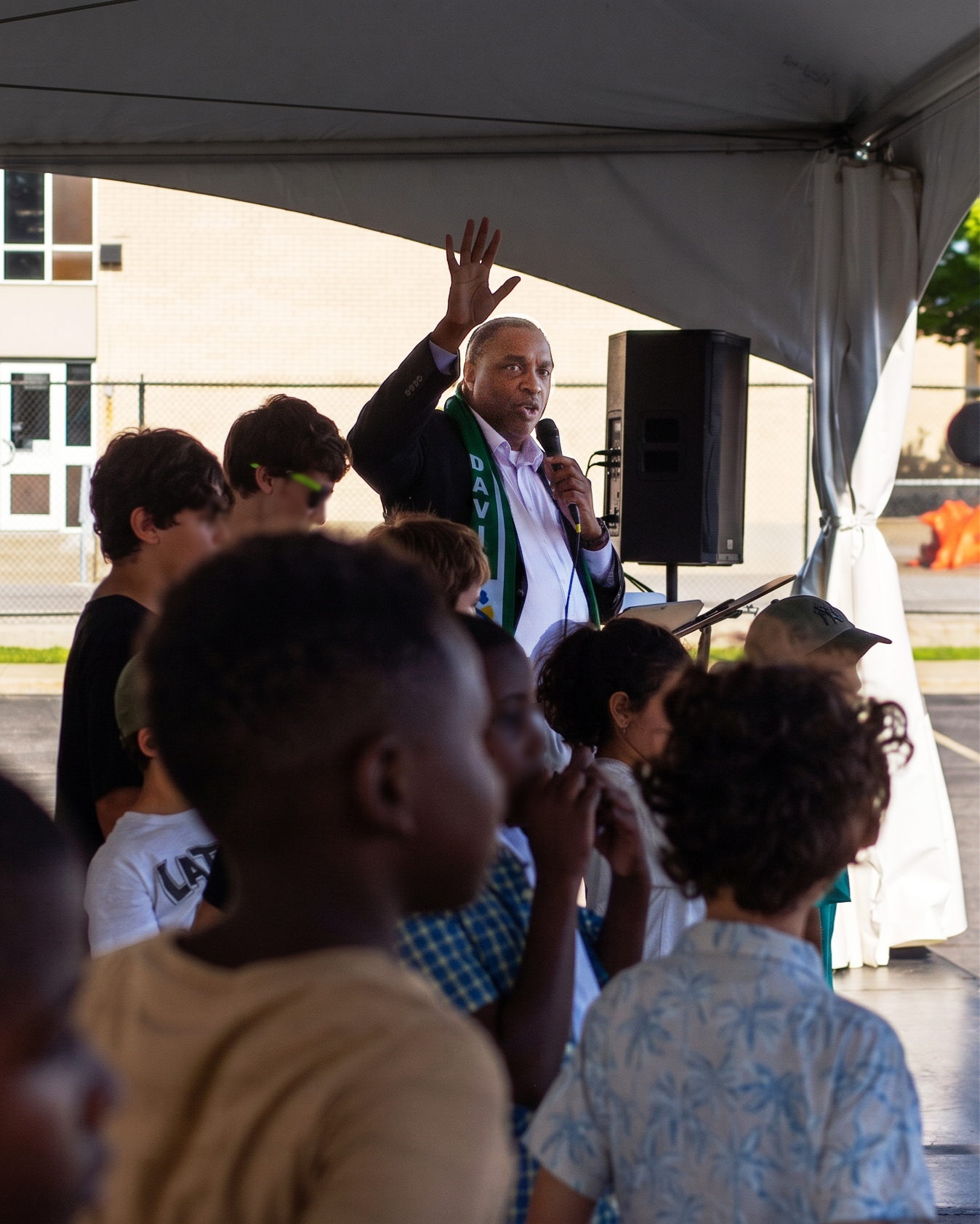
At the multicultural festival in Vanier, I gave an address on behalf of the Fondation Colorément Numérique / Colourfully Digital Foundation. Right in the middle of it, I invited the children in the crowd to come up and join me on the stage. They climbed up.
« Regardez cette belle jeunesse. C'est pour eux qu'on est là. » — Look at this beautiful youth. That's who we're here for.
I also said, on behalf of the Foundation: « notre but ultime est de préparer le terrain pour que chacun d'entre eux ait plus tard une vraie place autour des tables décisionnelles où se dessine notre société. » — our ultimate goal is to prepare the ground so that each of them, later on, has a real seat at the decision-making tables where our society takes shape.
The Turn
For a few seconds, the children were at the front, in the place where decisions get announced. But the table where decisions about their schools actually get made — the board table, the budget line, the policy vote — is a table no child can climb onto. Nobody invites them to sit down. They are the only people in the room whose entire future is on the agenda, and who have neither a seat nor a vote.
By the end of the day, I knew the answer I'd been giving all day was not the reason I'm running. Breaking the default is what I need voters to do. It is not why I'm running.
I'm running for the CECCE, the Conseil des écoles catholiques du Centre-Est, in Zone 6, because there are people who can't be at the table. Our kids.
What Qualifies, Not What Motivates
I've spent the last six years building after-school programs, and most of my life teaching and organizing activities for children and youth. Two decades of planning for them taught me how to be useful in a room full of children.
None of that is the reason I want this seat. It's what qualifies me to hold it properly. A school trustee's job is not to represent themselves. It's to be the seat that the children don't have.
Back to School, Again
When they walk through those doors, this week or next, someone, at that table, should have been thinking of them. That is why I'm running.